
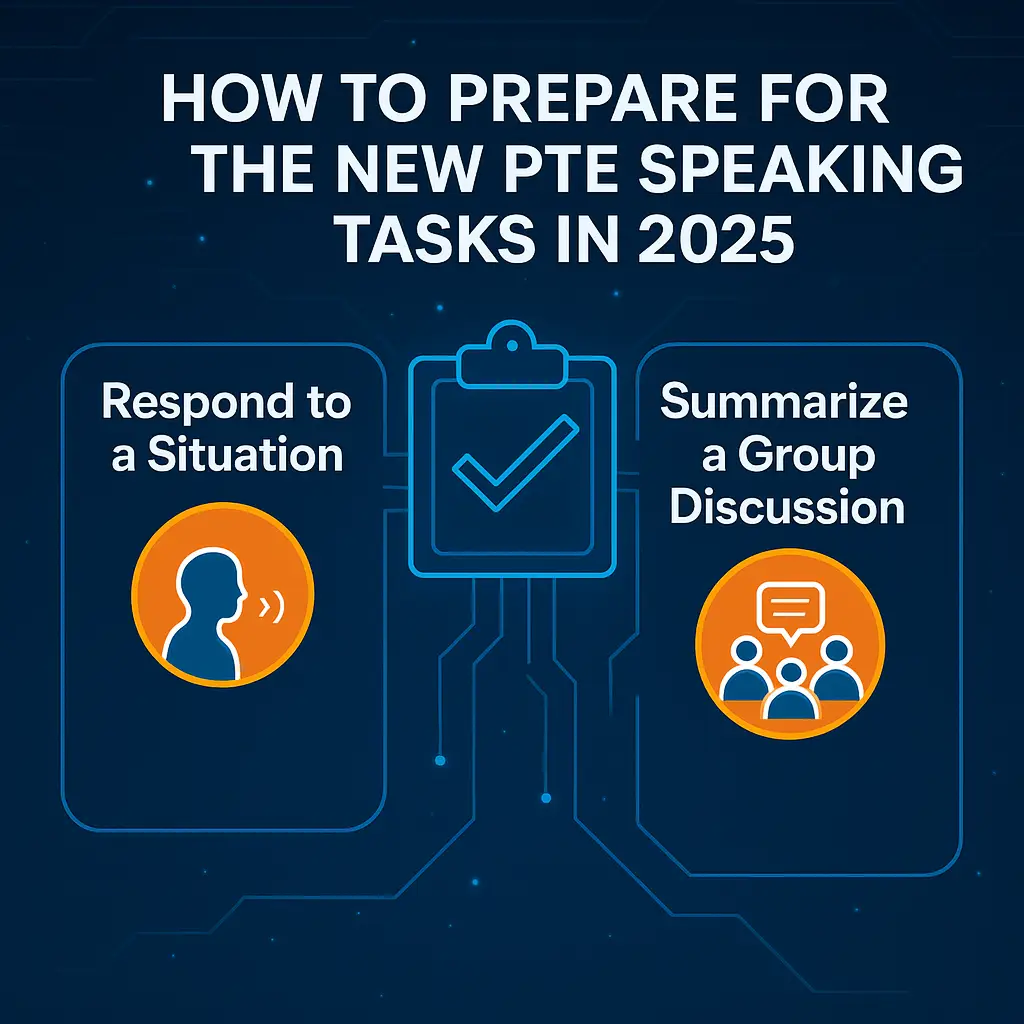
The PTE Academic exam is evolving — and with it, so should your preparation. From August 7, 2025, two new speaking tasks will become part of the official test format: “Respond to a Situation” and “Summarize a Group Discussion.”
These tasks are designed to evaluate how well you can handle real-life English communication, not just memorize answers.
If you’re unsure how to approach them, this blog is your roadmap. Let’s explore what these tasks involve, why they matter, and how you can train effectively to succeed.
🗣️ Task 1: Respond to a Situation
📌 What Is It?
This task presents you with a real-world scenario (e.g., you’re late for a meeting, you’re making a complaint at a restaurant, etc.). You must respond naturally — as if you were speaking to someone in person.
🧠 What It Tests
- Spontaneity and fluency
- Tone and appropriateness
- Ability to handle different social situations
✅ How to Prepare
- Practice roleplay with a partner or language tutor
- Record yourself responding to prompts like:
- “You just missed your flight. Speak to the airline representative.”
- “You need to reschedule a doctor’s appointment. Leave a voicemail.”
- Focus on clarity and tone — are you polite, assertive, natural?
🗨️ Task 2: Summarize a Group Discussion
📌 What Is It?
You’ll listen to a short group discussion involving 2–4 speakers. Your job is to summarize the main ideas in your own words.
🧠 What It Tests
- Active listening and comprehension
- Note-taking skills
- Paraphrasing and summarizing
✅ How to Prepare
- Watch panel discussions, podcasts, or interviews on YouTube. Practice summarizing them in under a minute.
- Use prompts like:
- “Summarize this discussion about online education.”
- “What were the main concerns raised in the conversation?”
- Focus on:
- Who said what?
- What was the conclusion?
- Were there any contrasting opinions?
🎯 Why These Tasks Are a Game-Changer
Unlike other PTE speaking tasks that allow for some memorization or repetition, these new tasks are about:
- Thinking on your feet
- Understanding nuance and tone
- Speaking like you would in a real conversation
They give you a chance to show your true English ability, and that’s what global universities, employers, and immigration departments want to see.
🧩 General Tips to Master the New PTE Speaking Tasks
- Practice daily in a natural setting – not just test environments.
- Use cue cards or scenario flashcards to simulate real-life situations.
- Improve note-taking by using keywords and speaker initials during audio.
- Focus on paraphrasing instead of repeating exact sentences.
- Record yourself and listen back to spot hesitation, repetition, or unclear pronunciation.
📦 Free Practice Prompts to Get You Started
🎙 Respond to a Situation
- “You received the wrong order on Uber Eats. Call customer support.”
- “You forgot your friend’s birthday. Leave a voice message to apologize.”
- “You’re applying for a part-time job at a bookstore. Answer why you’re interested.”
📋 Summarize a Group Discussion
- Watch this discussion: [Insert YouTube panel link]
Prompt: “Summarize what the speakers say about climate change.” - Listen to a podcast clip about remote work.
Prompt: “What are the benefits and drawbacks according to each speaker?”
⏰ Final Advice: Don’t Wait for the Change — Train for It Now
Even if your test is scheduled later this year, it’s wise to start training with the new task styles. The more naturally you handle spontaneous speaking and summarization, the more confident you’ll be on test day.
These tasks aren’t here to trick you — they’re here to show your real ability to communicate in English. So speak up, take notes, and get used to thinking in real time.